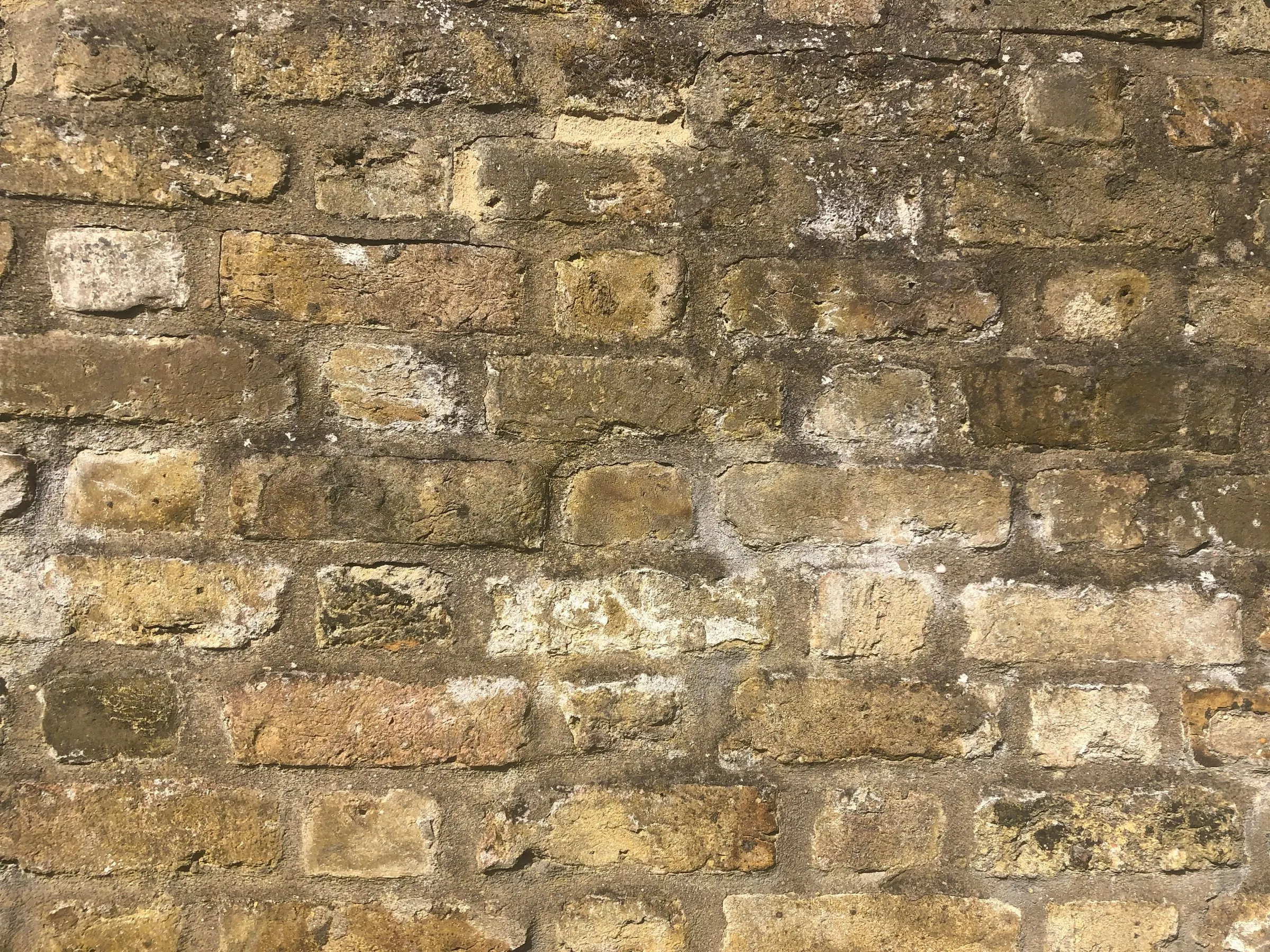
In short
- Older brick houses were usually built in lime mortar, which is softer and more porous than cement.
- Lime lets the wall dry out through the joints. Hard cement pushes the moisture into the bricks instead.
- Cement pointing on soft bricks often leads to crumbling, flaking brick faces over time.
- If the house was built in lime, repoint it in lime. If it was built in cement, cement is usually fine.
What is the difference between lime and cement mortar?
Both bind sand into a mortar that bonds the bricks and fills the joints. The difference is in how hard they set and how much moisture they let through.
Lime mortar sets slowly, stays relatively soft and is porous. Water that gets into the wall can evaporate back out through the joints. Cement mortar sets quickly, hard and dense, and lets far less moisture pass.
Portland cement was patented in 1824, but lime remained the normal mortar for houses through the Victorian period. Cement mortars took over gradually during the twentieth century.
Why the joint should be weaker than the brick
In a lime-built wall, the mortar is meant to be the weak point. It is softer and more porous than the brick, so moisture, salts and weathering work on the joint rather than the brick face. The mortar wears away slowly and is replaced every few generations. The bricks stay intact.
Put hard cement into that wall and the roles reverse. Moisture can no longer leave through the joints, so it moves through the bricks. In winter it freezes in the brick faces, and soft bricks start to flake and crumble while the cement stands proud around them. The SPAB and Historic England both warn against cement repointing of historic brickwork for this reason.
How to tell whether your house is built in lime
A builder who knows lime will check this on the first visit. You can get a fair idea yourself:
- Age: a house built before about 1914 is very likely to have been built in lime, even if it has since been repointed in cement.
- Colour and texture: lime mortar is often pale cream or buff, sometimes with small white lumps of lime in it. Cement mortar is usually grey and uniform.
- Hardness: original lime mortar can often be scratched with a key. Cement is hard and will not give.
- Look at the brick faces: bricks eroding back behind hard grey joints are a common sign of cement pointing on a lime-built wall.
Repointing a lime-built house
If the wall was built in lime, it has to go back in lime. That means raking out the old mortar carefully by hand rather than grinding it out, which can widen the joints and chip the brick edges. The SPAB suggests raking out to about twice the joint width.
The new mortar is matched to the old for colour, texture and strength, and must be protected from frost, rain and fast drying while it cures. Lime work is usually best avoided in the depths of winter.
Existing cement pointing can be taken out and replaced in lime, but it needs care: cement is often bonded so hard that removing it damages the brick edges. Sometimes the kinder option is to leave sound cement alone and repoint only where it has failed.
When cement mortar is the right choice
Houses built from the mid-twentieth century onwards, with harder machine-made bricks, were usually built in cement mortar. Repointing them in a matching cement mortar is normal and correct. The rule is the same either way: match the mortar to how the wall was built.